Home / Blog / Coins & Currency
Two Dollar Bill Value in 2026 — Which Ones Are Actually Worth More
Most $2 bills are worth exactly $2. Here are the specific ones that are not — red seals, star notes, fancy serial numbers and large-size notes — and how to check real-time market prices.
Quick answer
Almost every $2 bill in circulation today is worth exactly $2. The modern series (1976 and later) was printed in the hundreds of millions and gets hoarded rather than spent, so there is no scarcity to create a premium. The exceptions are real but specific: pre-1928 large-size notes, 1928 red-seal legal tender notes, star notes, low or fancy serial numbers, and genuinely uncirculated examples with sharp corners and no folds. Those range from a few dollars over face to several hundred, and in rare large-size cases into the thousands.
Are 2 dollar bills worth anything?
This is the most common question about US currency, and the honest answer disappoints most people holding one. The 1976, 1995, 2003, 2013 and 2017 series $2 bills are common. The 1976 series was reintroduced with great fanfare for the U.S. Bicentennial, and millions of people saved them, believing they would become valuable. This very act of hoarding ensured they would not. Subsequent series were also printed in large quantities—over 500 million for the 2003 series alone—and public perception that they're "unusual" means they are pulled from circulation far more often than other denominations. The result is a massive surviving population relative to collector demand. A crisp modern $2 bill taken directly from a bank strap is worth $2 to $3. A circulated one with a fold is worth exactly $2.
What creates value in paper currency is the same thing that creates value in coins and cards: scarcity plus condition plus demand. A $2 bill only clears that bar when something about that specific note is uncommon. This could be its age, the color of its seal, a unique serial number, or an error made during its printing process. For 99% of the two-dollar bills you encounter, these special features are absent.
A Deep Dive into Large-Size $2 Notes (1862-1918)
Before 1928, all U.S. currency was physically larger, measuring approximately 7.4 inches by 3.1 inches. These "large-size" notes are all obsolete and highly sought after by collectors. They are true pieces of history, and their value is consistently high. If you have a $2 bill this large, it is absolutely worth investigating further. Condition is critical, but even heavily worn examples are worth hundreds of dollars.
Here are some of the major types you might encounter:
- First Issue Legal Tender (1862): These notes feature a portrait of Alexander Hamilton. Their most distinctive feature is a large, ornate "2" on its side, earning them the nickname "Lazy Deuce." These are rare and valuable, with prices starting around $300-$500 for heavily circulated, damaged examples and soaring into the $5,000-$15,000+ range for nice, problem-free notes.
- National Bank Notes (1875): Also featuring the "Lazy Deuce" design on the back, these notes are unique because they were issued by individual national banks across the country, not the federal government directly. The bank's name is printed on the front. Their value depends heavily on the rarity of the issuing bank, often ranging from $400 to well over $10,000.
- Silver Certificates (1886, 1891, 1896): These notes were backed by silver held in the Treasury. The 1886 note features General Winfield Scott Hancock, while the 1891 features William Windom. The most famous is the 1896 $2 Silver Certificate, part of the legendary "Educational Series," featuring an allegorical scene of "Science presenting Steam and Electricity to Commerce and Manufacture." Circulated examples of these start around $150-$300, with uncirculated notes fetching thousands.
- Treasury or "Coin" Notes (1890-1891): Featuring a portrait of Treasury Secretary William Manning, these notes were redeemable in gold or silver coin. They are quite popular with collectors. A circulated 1890 $2 Treasury Note typically sells for $300-$800, with uncirculated examples easily exceeding $3,000.
- Federal Reserve Bank Notes (1918): The last of the large-size $2 bills, this note features a portrait of Thomas Jefferson on the front and a WWI-era battleship on the back, earning it the nickname "Battleship note." In circulated condition, they trade for $100-$250, while uncirculated examples can bring $700 or more.
Valuing Red Seal $2 Bills (1928, 1953, 1963)
The first small-size notes marked a new era for U.S. currency. For the $2 bill, this era included notes with a prominent red Treasury seal on the right side of the portrait. These are known as United States Notes or Legal Tender Notes. While not as rare as large-size notes, they consistently carry a premium over face value.
Series of 1928 $2 Bills
This was the first small-size $2 bill. All 1928 notes have a red seal. There are several sub-series (1928, 1928A, B, C, D, E, F, G) distinguished by changes in the signatures of the Treasurer and Secretary of the Treasury. The 1928C, D, E, F, and G series are generally more common. A circulated 1928 red seal is a dependable seller in the $10 to $30 range. Lightly circulated examples can bring $30 to $60. If you have a crisp, uncirculated note with sharp corners and no folds, it could be worth $75 to $150, with scarcer series like 1928B commanding even more.
Series of 1953 & 1963 $2 Bills
These later red seal notes are much more common than the 1928 series but still carry a premium. The design is similar, but there are subtle changes. The 1963 series was the first to add the motto "In God We Trust" above Monticello on the back.
- 1953 Series (A, B, C): A heavily circulated 1953 red seal is worth $3 to $5. In lightly circulated (AU) condition with just a single fold, it jumps to $6 to $10. A truly uncirculated, crisp note can sell for $15 to $30.
- 1963 Series (and 1963A): Values are very similar to the 1953 series. Expect $3 to $8 for a circulated example and $12 to $25 for a perfect uncirculated one.
The Collector's Guide to $2 Star Notes
One of the most exciting things to look for on any bill is a star note. A star printed at the end of the serial number (in place of the final letter) indicates that this bill is a replacement for an original note that was found to be faulty during the printing process. To maintain correct numbering, the Bureau of Engraving and Printing (BEP) prints special runs of star notes to substitute for the errors. These runs are almost always significantly smaller than the regular production runs, creating instant scarcity.
The value of a star note depends on three factors: the bill's series, its condition, and the size of the star note print run. A star note from a large run of 3.2 million is less scarce than one from a run of 64,000. Here are some general value ranges:
- Modern $2 Star Notes (1976 and later): These are the most common star notes you'll find. In circulated condition, they typically sell for $5 to $15. In uncirculated condition, they can range from $20 to $50. However, certain modern star note runs are exceptionally rare and can be worth hundreds of dollars. The 2013 issue from the Atlanta Federal Reserve (F*) is a famous example that can command over $200 in uncirculated condition.
- Red Seal $2 Star Notes (1928, 1953, 1963): These are much scarcer and more desirable. A circulated 1953 or 1963 star note can easily be worth $20 to $50. An uncirculated one can fetch $75 to $150+. A 1928 star note is a true prize, with circulated examples starting around $100 and uncirculated notes soaring to $500-$1000 or more.
Unlocking Value with Fancy Serial Numbers
Beyond the series and seal, the 8-digit serial number itself can create significant value. This is a collecting field driven purely by aesthetics and rarity. Spotting these patterns requires a keen eye, but the payoff can be substantial. These premiums apply to any denomination, but finding one on a less-common $2 bill can add to the appeal. Keep an eye out for these types:
- Low Serial Numbers: Any note with a serial number under 1000 is desirable. Under 100 is even better. A note like 00000088 will carry a premium of $100 to $300+ over a standard bill. A single-digit number is the ultimate prize, often selling for thousands.
- Solid Serial Numbers: All eight digits are the same (e.g., 22222222). These are exceptionally rare, with only a handful existing for any given series. They are worth $3,000 to $8,000+.
- Ladder Serial Numbers: The digits are in sequential order, either up (12345678) or down (87654321). These are also extremely rare and valuable, often trading in the $800 to $2,500+ range.
- Radar Serial Numbers: The number is a palindrome, reading the same forwards and backwards (e.g., 12344321). These are the most commonly found "fancy" serial number and add a premium of $20 to $100 depending on condition.
- Repeater Serial Numbers: The digits repeat in a pattern, such as 12341234 (a Super Repeater) or 56756756 (a Repeater). These carry a smaller premium, typically $10 to $50.
- Birthday Notes: A specific date encoded in YYYYMMDD or MMDDYYYY format. For example, a note with the serial 07041776 would be a huge prize for a U.S. history buff. The value is speculative and depends entirely on finding a buyer for whom the date is significant.
- Misprints and errors. Ink smears, mismatched serials, off-center cuts and inverted overprints are the highest-upside category, and also the most faked. A major error, like an inverted back, can be worth thousands, but requires professional authentication.
Understanding Paper Money Grading and Its Impact on Value
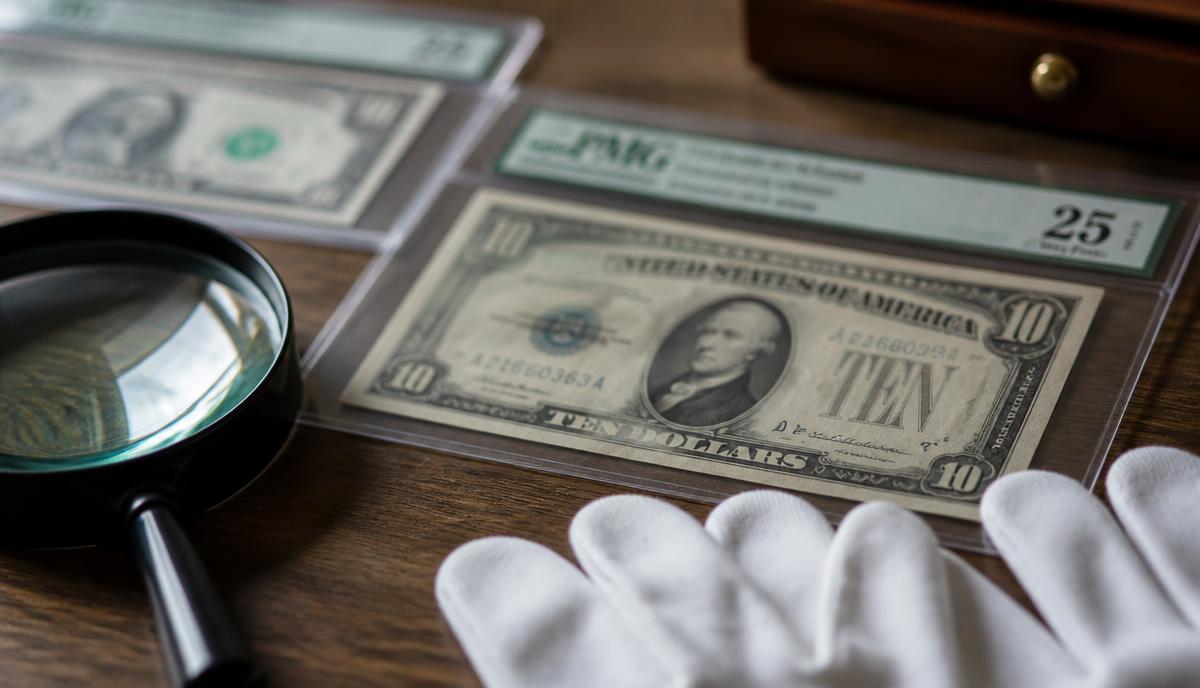
Grade drives everything in paper money. A single hard center fold can cut a note's value in half, and the difference between "about uncirculated" and "gem uncirculated" is a corner nobody can see without looking closely. Professional grading services like PMG (Paper Money Guaranty) and PCGS Banknote use a 70-point scale to standardize condition, which gives buyers confidence.
Here's a simplified breakdown of the key grading tiers:
- Gem Uncirculated (65-70): A perfect note. It has never been folded or spent. The paper is crisp, the corners are razor-sharp, and the centering is nearly perfect. These command the highest prices.
- Choice Uncirculated (63-64): Appears perfect at first glance but may have a minor issue like a slight counting smudge or being just off-center. Still a high-end note.
- About Uncirculated (AU 50-58): The key distinction is a single light fold, usually down the center. Otherwise, the note looks brand new. This one fold can reduce the value by 30-50% compared to a Gem Uncirculated example.
- Extremely Fine (XF 40-45): Has a few light folds (typically three or fewer) but still retains crispness.
- Very Fine (VF 20-35): Shows clear signs of circulation with multiple soft and hard folds, but the paper is not limp. Corners may show slight rounding.
- Fine (F 12-15) and Below: Heavily circulated, limp paper, rounded corners, possible stains or small tears. Value drops significantly at these grades.
Collectors also pay for originality. A note that has been washed with chemicals, pressed under a book to flatten folds, or trimmed to sharpen corners is considered damaged goods and will be worth less than an honest circulated example. Graders will note these issues, killing the premium.
Where to check live market prices, not asking prices
The mistake almost everyone makes is searching active listings on eBay or other marketplaces. Anyone can list a common 1976 $2 bill for $500; that's just an asking price and it tells you nothing about the bill's actual value. To find the truth, you must filter your search results to show sold or completed listings only. This reveals what real buyers actually paid for the same series, seal colour, condition and serial-number type as your note. If you find only a handful of sales, widen the date range rather than trusting a single outlier.
The FlipAI what's it worth tool streamlines this critical step. Just take a photo of your item—whether it's currency, a collectible, or something from your attic—and the app analyzes a database of real market sales. It provides a value range and a confidence score that tells you how much data is available, preventing you from making decisions based on a single, unreliable comp. For currency, photograph the note flat in even light so the series year, seal colour and serial number are all legible.
How to check your $2 bill in 60 seconds
- Read the series year under the portrait on the right. Is it modern (1976+) or older?
- Check the seal colour. Green is modern Federal Reserve; red means legal tender (1928–1963) and is worth a premium; brown or blue means something much older and more valuable (large-size notes).
- Look for a star at the end of the serial number. If present, it's a star note and is worth more.
- Read the serial for a pattern — solid, ladder, radar, repeater, or a very low number like 00000100 or below.
- Assess folds. Hold it at an angle to the light. Count the creases honestly. The difference between no folds, one center fold, and multiple folds is huge for value.
- Scan it and compare the range against sold examples in matching condition before you list or sell. This final step prevents you from either giving away a valuable note or asking an unrealistic price for a common one.
Should you get a note graded?
Third-party grading from services like PMG or PCGS Banknote involves sealing the note in a protective holder with a label that guarantees its authenticity and condition. This process costs money—typically $25 to $60+ per note depending on its value and the desired turnaround time, plus the cost of insured round-trip shipping. The total cost can easily be $40-$80 per note. Therefore, grading only makes financial sense when the graded sold price clearly exceeds the raw (ungraded) price by more than the total fee.
Here’s a simple cost-benefit analysis:
- For a common modern $2 bill: Never. The cost of grading would be many times the note's value.
- For a modern $2 star note: Usually no. If it sells for $20 raw and $45 graded, you'd lose money after fees.
- For a sharp 1928 red seal or a valuable fancy serial number: Often yes. A crisp 1928 red seal might sell for $80 raw. But in a Gem Uncirculated 66 holder, it could sell for $250. The $170 increase in value easily justifies the grading fee.
- For a large-size note or a major error: Almost always yes. For these high-value items ($500+), grading provides authentication and removes all doubt for the buyer about condition, pressing, or repairs. This is essential to realizing the note's maximum value.
Effective Strategies for Selling Your $2 Bills
Once you've identified and valued your bill, you need a strategy to sell it. The best platform depends on the note's value and type. For detailed insights on selling, check out our comprehensive reseller guide.
- eBay: The largest marketplace, offering a huge audience of collectors. It's ideal for graded notes, star notes, and fancy serial numbers that people are actively searching for. The main downside is the fees, which are typically 13.25% of the total sale price (including shipping), plus a small fixed fee.
- Local Coin/Currency Dealer: The best option for a fast, hassle-free cash sale. Dealers will pay immediately but will offer a wholesale price (typically 50-70% of the retail value) so they can resell it for a profit. This is a good route for lower-value circulated red seals or if you are selling a large collection in bulk.
- Heritage Auctions (or other major auction houses): The premier venue for extremely rare and high-value notes, like Gem large-size bills or major errors. They reach the world's top collectors and can achieve record prices, but they charge significant consignment fees (a seller's premium and a buyer's premium).
- Online Forums & Facebook Groups: Communities dedicated to currency collecting can be a great place to sell directly to knowledgeable buyers, often with lower fees than eBay. However, you'll need to build a reputation within the community to make significant sales.
Before you decide where to sell, use a profit calculator to compare your potential net earnings. Factoring in fees and shipping costs is crucial to understanding what you'll actually walk away with from each platform.
What to do with the common ones
If your bill is a standard modern $2 from 1976 or later with no special features, you have two sensible options: spend it, or bundle it. People enjoy receiving them as change or as tips precisely because they're uncommon to see. Sellers do move packs of consecutive-serial modern $2 bills for a small premium over face value. These are often bought as gifts, stocking stuffers, or for events like a Lunar New Year celebration. A full, uncirculated "strap" of 100 consecutive notes from a bank will sell more easily than 100 individual notes. What does not work is listing a single, circulated 1976 note for $50 and waiting for a buyer who doesn't exist.
Related value checks
Currency is usually found alongside other inherited or attic items, so it is worth checking those in the same session. If you have a box of mixed collectibles, the what's it worth tool can help identify and value unknown items. Many people who collect paper money also collect coins, and similar principles of scarcity and condition apply. For more articles on identifying and valuing collectibles, you can visit our reseller blog. Before selling anything online, always use a tool like the profit calculator to understand what your net proceeds will be after platform fees and shipping costs.
Get started
Download FlipAI on the App Store — 10 lifetime scans free, no credit card. Take a photo of any item or scan its barcode and see what it actually sells for.
Frequently asked questions
Is a 1976 Bicentennial $2 bill worth anything?
Generally, no. A circulated 1976 $2 bill is worth exactly $2. A crisp, uncirculated one might sell for $3-$4. They were printed in massive quantities and saved by the public, so they are not rare. The only exceptions are star notes or notes with fancy serial numbers.
What makes a $2 bill a 'star note' and is it valuable?
A star note has a small star at the end of its serial number instead of a letter. It indicates the note is a replacement for a misprinted one. Because they are printed in smaller quantities, they are scarcer and almost always worth more than face value, ranging from $5 to thousands of dollars depending on the series and rarity.
How much is a $2 bill with a red seal worth?
It depends on the year and condition. A common circulated 1953 or 1963 red seal is worth about $3-$8. A 1928 series red seal in similar condition is worth more, around $10-$30. Uncirculated examples of any red seal are worth significantly more, from $15 to over $150.
Is it expensive to get a $2 bill graded?
Yes, it can be. Professional grading by services like PMG or PCGS typically costs $25-$60 per note, plus shipping. It only makes sense for notes where the increase in value from being graded (e.g., from $80 raw to $250 graded) far exceeds the total cost of the service.
Where is the best place to sell a valuable $2 bill?
For high-value notes (over $100), eBay is a good option to reach a large audience of collectors. For extremely rare notes (over $1,000), a major auction house like Heritage may yield the best results. For lower-value notes or quick cash, a local coin and currency dealer is your best bet, though they will pay wholesale prices.
Frequently Asked Questions
Is a 1976 Bicentennial $2 bill worth anything?
Generally, no. A circulated 1976 $2 bill is worth exactly $2. A crisp, uncirculated one might sell for $3-$4. They were printed in massive quantities and saved by the public, so they are not rare. The only exceptions are star notes or notes with fancy serial numbers.
What makes a $2 bill a 'star note' and is it valuable?
A star note has a small star at the end of its serial number instead of a letter. It indicates the note is a replacement for a misprinted one. Because they are printed in smaller quantities, they are scarcer and almost always worth more than face value, ranging from $5 to thousands of dollars depending on the series and rarity.
How much is a $2 bill with a red seal worth?
It depends on the year and condition. A common circulated 1953 or 1963 red seal is worth about $3-$8. A 1928 series red seal in similar condition is worth more, around $10-$30. Uncirculated examples of any red seal are worth significantly more, from $15 to over $150.
Is it expensive to get a $2 bill graded?
Yes, it can be. Professional grading by services like PMG or PCGS typically costs $25-$60 per note, plus shipping. It only makes sense for notes where the increase in value from being graded (e.g., from $80 raw to $250 graded) far exceeds the total cost of the service.
Where is the best place to sell a valuable $2 bill?
For high-value notes (over $100), eBay is a good option to reach a large audience of collectors. For extremely rare notes (over $1,000), a major auction house like Heritage may yield the best results. For lower-value notes or quick cash, a local coin and currency dealer is your best bet, though they will pay wholesale prices.