How Much Is My Sports Card Worth in 2026?
How Much Is My Sports Card Worth in 2026?
So, you're holding a sports card and asking yourself, "how much is my sports card worth"? The answer, my friend, is it depends! While some cards might barely cover the cost of a gumball, others can fetch prices soaring into the millions. It's a thrilling hunt, a true treasure trove for those who know how to spot the gems.
Related reading: Where to Sell Sports Cards Online in 2026 · Best Place to Sell Sports Cards in South Carolina 2026 Guide · Best Place to Sell Sports Cards in Nebraska 2026 Guide
As a reseller, I’ve seen everything from dust collectors to dream cards come across my desk. The key to unlocking that value isn't just luck; it's understanding the market, knowing what makes a card desirable, and using the right tools to get an accurate appraisal. We're talking about real money here, and you wouldn't want to leave it on the table. In this guide, we'll dive deep into valuing your sports cards, checking live market prices, and leveraging tools like FlipAI to become a card-selling pro. Let's get those cards appraised and turn them into cash!
Quick Answer: How Much Is My Sports Card Worth?
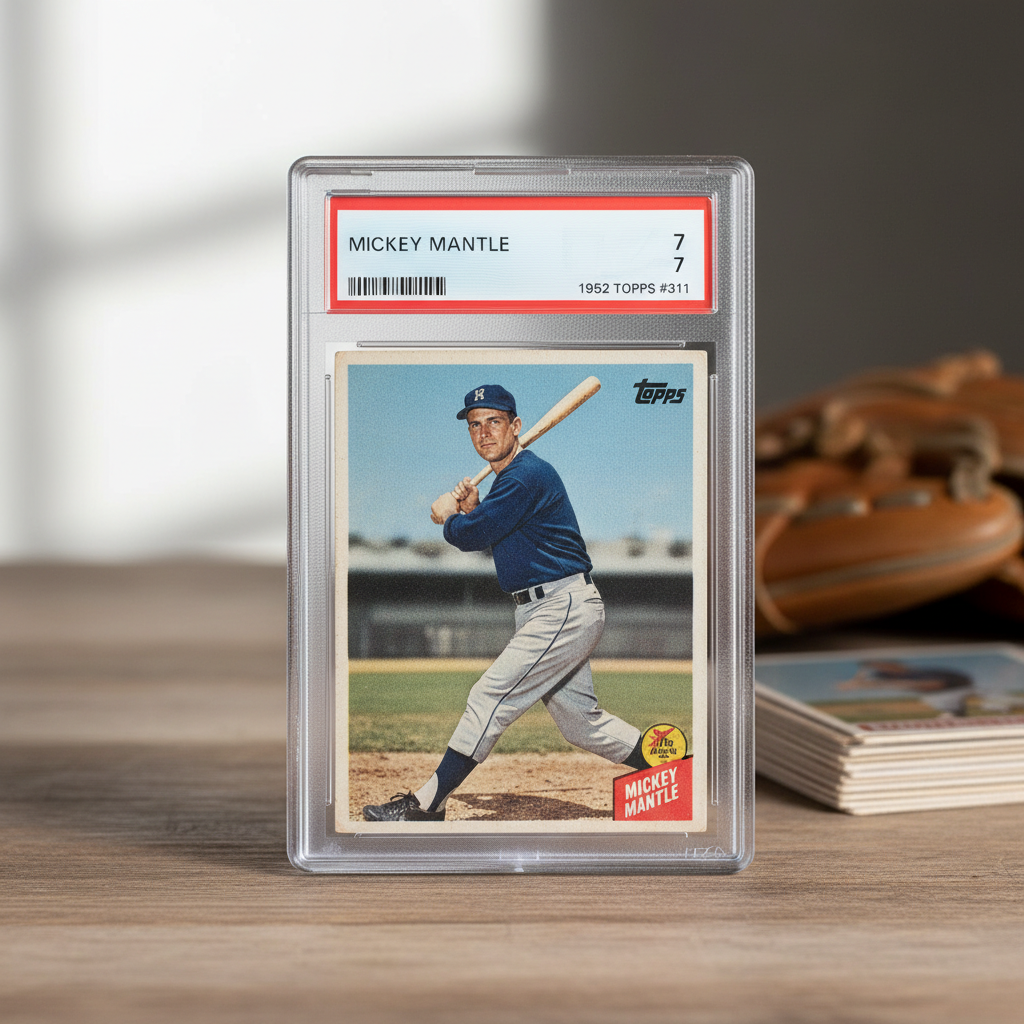
Okay, let's get right to it. "How much is my sports card worth?" The quick answer is: anywhere from a few cents to seven figures! Seriously, I'm not kidding. Most common modern cards will fetch less than a dollar, unless they're rare parallels, autographed, or rookie cards of future Hall of Famers. On the other hand, a highly sought-after, PSA 10 graded rookie card of a legendary player like Michael Jordan or Mickey Mantle could easily command tens of thousands, hundreds of thousands, or even millions of dollars. For instance, a 1986 Fleer Michael Jordan rookie card in a PSA 10 condition routinely sells for over $10,000, and some rare examples have hit six figures. A 1952 Topps Mickey Mantle in high grade? We're talking upwards of $1 million.
The vast majority of cards, especially those from the '80s and '90s "junk wax" era, often hold very little value individually. However, even within those years, key rookie cards or rare inserts can still surprise you. For example, a 1989 Upper Deck Ken Griffey Jr. rookie card, even raw, can still bring in $50-$100 if it's in great condition, and significantly more if graded highly. It all boils down to a combination of factors we’ll explore, but don't assume every old card is a goldmine, and certainly don't assume every new card is worthless. The market is dynamic, constantly shifting with player performance, collector trends, and even pop culture events. This is why knowing how to do a proper card value lookup is so crucial.
What Drives Sports Card Value in 2026?
Understanding what makes a sports card valuable is like cracking a secret code, and trust me, once you get it, you'll be ahead of most casual collectors. There isn't just one factor; it's a perfect storm of several elements that converge to create a high-value card. Let's break down the major drivers:
- Player Popularity & Hall of Fame Potential: This is probably the biggest factor. Cards of iconic players (think LeBron James, Tom Brady, Wayne Gretzky) or rising stars with Hall of Fame potential are always in demand. Their on-field achievements directly impact their card values. A player having a breakout season can send their rookie card prices soaring.
- Year & Set: Certain years and sets are more desirable than others. Vintage sets (pre-1980s) often hold significant value due to scarcity and historical importance. Modern sets from brands like Topps Chrome, Bowman Chrome, Panini Prizm, or Upper Deck Young Guns are highly sought after for their rookie cards and parallels.
- Rookie Card Status: Rookie cards are the holy grail for most collectors. These are typically the first officially licensed cards of a player in their professional uniform. The phrase "rookie card prices" is one you'll hear often among serious collectors because these usually carry a premium.
- Parallel Cards & Short Prints: Manufacturers create different versions (parallels) of base cards, often with unique colors, textures, or numbering (e.g., /25, /99). These are intentionally produced in limited quantities (short prints) and are significantly rarer and more valuable than their base counterparts. Think about a Topps Chrome Refractor or a Panini Prizm Gold parallel – these are where the serious money often resides.
- Autographs & Memorabilia: Cards featuring on-card autographs or pieces of game-used memorabilia (jersey patches, bat pieces) are inherently more valuable, especially if they're authenticated.
- Grading (PSA, BGS, SGC): This is HUGE. A card's condition, professionally assessed by a third-party grading company like PSA, Beckett (BGS), or SGC, can multiply its value by orders of magnitude. A PSA 10 (Gem Mint) card is significantly more valuable than a raw, ungraded card, even if they look identical to the naked eye. We'll talk more about PSA grading later, but for now, just know that a higher grade almost always means a higher price.
- Print Run/Scarcity: The fewer copies of a card that exist, the more valuable it tends to be. This is why super short prints (SSP) or 1/1 (one of one) cards command astronomical prices.
By understanding these factors, you can better assess your collection and pinpoint which cards are likely worth a closer look. And honestly, this is where a tool like FlipAI really shines, helping you quickly identify these attributes.
How to Check live market Comps for Sports Cards
This is where the rubber meets the road, folks. Knowing what drove a card's value in theory is one thing, but seeing what collectors are actually paying for it is another. The best way to determine "how much is my sports card worth" is by looking at *real-time market comparable listings* (comps). And when we talk about comps, we're primarily talking about eBay's sold listings. It's the largest marketplace for sports cards, and its sold data is the most reliable indicator of market value. I use this method daily for all sorts of items, not just cards. If you're serious about reselling, this should be your go-to method.
Step-by-Step Comps Check:
- Identify Your Card: Make sure you know the player, year, set, card number, and any specific characteristics (e.g., Refractor, SP, Auto, numbered /99).
- Go to eBay: Head over to ebay.com.
- Search Clearly: Enter specific keywords for your card. For example: "2018 Topps Chrome Ronald Acuña Jr. Refractor Rookie PSA 9". Be as precise as possible.
- Filter for Sold Listings: This is the crucial step! On the left-hand sidebar (or within the filters menu on mobile), find and select "Sold Items" and "Completed Items." This will show you exactly what people have paid for that specific card recently.
- Analyze Results: Look at recent sales. Compare your card's condition (or its estimated condition if ungraded) to the sold listings. Pay attention to grading company and grade number. Don't just look at the highest; look at the average of recent sales for similar conditions.
Realistic eBay Sold Examples:
- Example 1: You have a 2018 Topps Chrome Ronald Acuña Jr. Refractor Rookie Card. Searching "2018 Topps Chrome Ronald Acuña Jr. Refractor Rookie PSA 9" on eBay's sold listings might show recent sales ranging from ~$350 to $420. If your card is raw but looks gem mint, you might estimate it could grade as a PSA 9 or 10, giving you a good target value.
- Example 2: You found a 2000 Tom Brady Playoff Contenders Rookie Auto RC #144. Searching for this card in a BGS 9.5 (which is Gem Mint) on eBay's sold listings could show prices upwards of $100,000, and in some cases, even $250,000+ depending on the specific subgrades and year. This card’s price is heavily influenced by grading and the autograph.
This method gives you the most accurate, real-time snapshot of the market. And guess what? This exact process is what tools like FlipAI streamline, using AI to do the heavy lifting for you by instantly showing you these comps by simply taking a picture of your card. For more general reselling strategies, check out our complete reseller's guide.
Best Places to Sell Your Sports Cards
Once you’ve figured out "how much is my sports card worth," the next logical step is to sell it! Knowing where to sell your cards can make a massive difference in how much profit you ultimately take home. Different platforms cater to different types of cards and different price points. As a multi-platform reseller myself, I always advise diversifying where you list, but strategic selling is key.
Top Selling Platforms:
- eBay: This is the king for sports card sales, hands down. For almost any card, from a $5 common parallel to a $50,000 graded vintage rookie, eBay is your best bet for reaching the widest audience and getting fair market value. The seller fees for most categories are around 13.25% of the final sale price, plus $0.30 per order, which can add up, but the exposure is unparalleled. For higher value items, they offer managed payments and seller protections.
- PWCC Marketplace & Goldin Auctions: If you have high-end, graded cards (think $500+ value, especially $5,000+), these auction houses are excellent options. They specialize in premium collectibles, offer professional photography and authentication, and attract serious, affluent buyers. Their fees vary but are generally competitive for high-value items, often structured as a commission on the final sale. Think of these as Sotheby's for sports cards.
- Facebook Marketplace / Local Card Groups: For lower-value raw cards (under $50), especially if you want to avoid shipping costs and fees, Facebook Marketplace or local sports card groups can be effective. You can often arrange local pickups. The downside is less buyer protection and potentially lower prices, but zero selling fees can be a huge bonus for small sales.
- COMC (Check Out My Cards): This platform is fantastic for selling a large volume of lower to mid-value cards without the hassle of individual listings and shipping. You send your cards to them, they process, scan, and list them, and you set the price. They take a commission, but it's great for passive income from your bulk.
- Consignment Shops & Card Shows: If you prefer a hands-off approach or enjoy the community aspect, local card shows or reputable consignment shops can be a good option. Always vet these carefully to ensure they are trustworthy and offer fair consignment rates.
Choosing the right platform depends on the card's value, your comfort level with shipping and customer service, and the fees you’re willing to pay. For selling on multiple platforms efficiently, consider looking into crosslisting tools. Crosslisting your items can significantly increase your sales velocity across platforms like eBay, Mercari (10% final value fee + $0.50 processing fee), and Poshmark (20% on sales over $15, flat $2.95 on sales under $15).
How FlipAI Values Cards in Seconds with AI Vision
Alright, so we've talked about the nitty-gritty of determining card value and the manual process of checking comps. But what if I told you there’s a faster, smarter way? That's right, I'm talking about FlipAI. As a seasoned reseller, I'm always looking for efficient tools, and this one is a game-changer, especially for "how much is my sports card worth" questions.
Here’s the cool part: FlipAI lets you take a photo of any item or scan its barcode to instantly see current eBay asking prices (live listings, not sold prices) plus an AI estimate. No guessing. No Googling. Just point your camera at anything and know what it is actually worth in about 10 seconds.
For sports cards, FlipAI's AI vision technology is practically magic. Instead of laborious inputting of player names, years, and set numbers, FlipAI can often detect all of this directly from a photo. It works by:
- AI Card Detection: Snap a clear photo of your sports card, and FlipAI's advanced AI will analyze the image to identify the player, year of release, card set, specific card number, and even rookie card status or parallel distinctions.
- Condition Recognition: While it won't give a professional PSA grade, the AI can assist in noting key visual factors that influence condition.
- Instant Market Comps: Once identified, FlipAI pulls up real, recent market listings from major marketplaces. This means you immediately see what similar cards have actually sold for, giving you an accurate market valuation. No more manually sifting through eBay's sold listings!
- Grading Company & Grade Identification: If your card is already graded by PSA, BGS, or SGC, the AI can often read the slab and factor that into its search, delivering comps for that specific grade.
This integration of powerful AI vision with real-time market data makes FlipAI an indispensable tool for anyone in the sports card game, whether you're a casual collector or a serious flipper. It literally cuts down hours of research into seconds. This is how you stay competitive and make those profitable buys. It’s like having an expert appraisal in your pocket. Check out the FlipAI homepage for more details on how this incredible tool can transform your reselling.
Grading: Is It Worth It or Not?
The question of whether to grade a sports card often boils down to a risk-reward calculation, especially when you're seriously considering "how much is my sports card worth" in its ultimate form. Grading from companies like PSA, Beckett (BGS), or SGC involves submitting your card for a professional authenticity and condition assessment. They encapsulate the card in a tamper-proof slab and assign it a numerical grade, typically from 1 to 10 (with 10 being Gem Mint, and 9.5 for BGS as Gem Mint, 10 as Pristine/Black Label). But is it always worth the time and expense?
When Grading IS Worth It:
- High-Value Cards & Key Rookies: For cards that are already projected to be worth hundreds or thousands of dollars (e.g., vintage Hall of Famer rookies, modern superstar rookies, rare parallels), grading is almost always a must. A PSA 10 of a desirable card can sell for 5x to 10x (or more) what a raw, perfect-looking version would. It provides authenticity and condition assurance to buyers.
- Maximizing Resale Value: Graded cards typically sell faster and for significantly higher prices. Buyers are more confident in a third-party opinion than their own assessment or a seller's personal grading.
- Long-Term Investment: If you view certain cards as long-term investments, grading protects them physically and preserves their condition, which is paramount for value retention.
- Scarcity & Rarity: For extremely rare cards (low serial numbers, 1/1s), grading solidifies their provenance and maximizes their value, especially if they grade highly.
When Grading MIGHT NOT Be Worth It:
- Low-Value Base Cards: If a card, even in perfect condition, is likely only worth $1-$5, the grading fees (which can range from $15 to hundreds per card, depending on declared value and submission speed) will far outweigh any potential increase in value. You'd lose money.
- Cards in Poor Condition: A card with significant flaws (creases, heavy corner wear, surface scratches) is unlikely to receive a high grade. A PSA 5 of a common card won't dramatically increase its value and often won't justify the grading cost. Use your best judgment here: if it looks like it's been through a washing machine, probably skip grading.
- Overly Abundant Modern Commons: The market is flooded with modern base cards. Even if a player is performing well, if it's not a rookie, a rare parallel, or an auto, grading it is usually not a wise financial decision.
Always do your homework using FlipAI's market comps *before* submitting. See what similar graded cards are selling for, and weigh that against the grading fees. If your raw card sells for $50, and a PSA 9 sells for $100, but grading costs $25, then you might only net $25 more (factoring in shipping costs to the grading company). That might be borderline on viability. However, if a raw card sells for $200 and a PSA 10 sells for $2000, then it's a no-brainer to grade.
Get Started Valuing Your Collection Today!
By now, you should have a solid understanding of how to answer the question, "how much is my sports card worth." We've covered the crucial factors like player prestige, rookie card prices, set rarity, and the undeniable impact of professional grading from entities like PSA. You also know the importance of checking real, sold comparable listings on platforms like eBay to get an accurate pulse on the market.
Armed with this knowledge, you are well on your way to becoming a savvy sports card reseller or collector. Whether you're unearthing vintage gems or speculating on future superstars, the principles remain the same: research, compare, and leverage reliable data. Don't let valuable cards sit in dusty boxes because you don't know their potential. The thrill of finding that hidden gem and turning it into profit is one of the best feelings in reselling.
To truly streamline your card valuation process and make informed decisions faster, there's no better tool than FlipAI. It takes the guesswork out of pricing by giving you instant sold data, saving you precious time and maximizing your profits. Stop manually searching and start selling smarter. Try FlipAI free with 10 lifetime scans — no credit card required.
Frequently Asked Questions
What is the fastest way to check my sports card's value?
The fastest way to check your sports card's value is by using an app like FlipAI. You simply take a photo of your card, and its AI vision technology will identify the player, year, set, and even grade if applicable, then instantly show you real-time market prices from multiple marketplaces like eBay. This eliminates manual searching and provides rapid valuations, allowing you to quickly determine current market worth.
Should I get my sports card graded by PSA?
Deciding whether to get your sports card graded by PSA (or BGS/SGC) depends largely on its potential value and condition. High-value rookie cards, rare parallels, or vintage cards in excellent condition (estimated to be a PSA 8 or higher) are generally worth grading to maximize their resale price and provide buyer confidence. However, for common cards, low-value modern base cards, or cards in poor condition, the cost of grading often outweighs the potential increase in value, making it an unprofitable endeavor.
How do I find rookie card prices?
To find accurate rookie card prices, your best bet is to check 'real-time market comparable listings' on major online marketplaces. Websites like eBay allow you to filter searches specifically for 'sold items' and 'completed listings,' which show what collectors have recently paid for that exact rookie card, often specifying grade (e.g., PSA 10). Tools like FlipAI can automate this by identifying your rookie card from a photo and pulling up these market comps instantly.
What factors make a sports card valuable?
Several factors contribute to a sports card's value. The most significant include the player's popularity and legacy (especially Hall of Fame status), whether it's a rookie card, its scarcity (e.g., low print run, limited parallels), any autographs or memorabilia inclusions, and its professional grade (e.g., PSA 10, BGS 9.5). The year and set of the card also play a role, with vintage and certain modern sets being more desirable.
Where are the best places to sell high-value sports cards?
For high-value sports cards, especially those that are graded and worth over $500, the best places to sell are typically specialized auction houses like PWCC Marketplace or Goldin Auctions. These platforms cater to serious collectors, offer professional presentation, and can fetch premium prices. For a broader market and slightly lower-end graded cards, eBay remains an excellent option due to its massive reach, attracting a wide range of buyers.