Art Deco Jewelry Identification and Value: The 2026 Guide
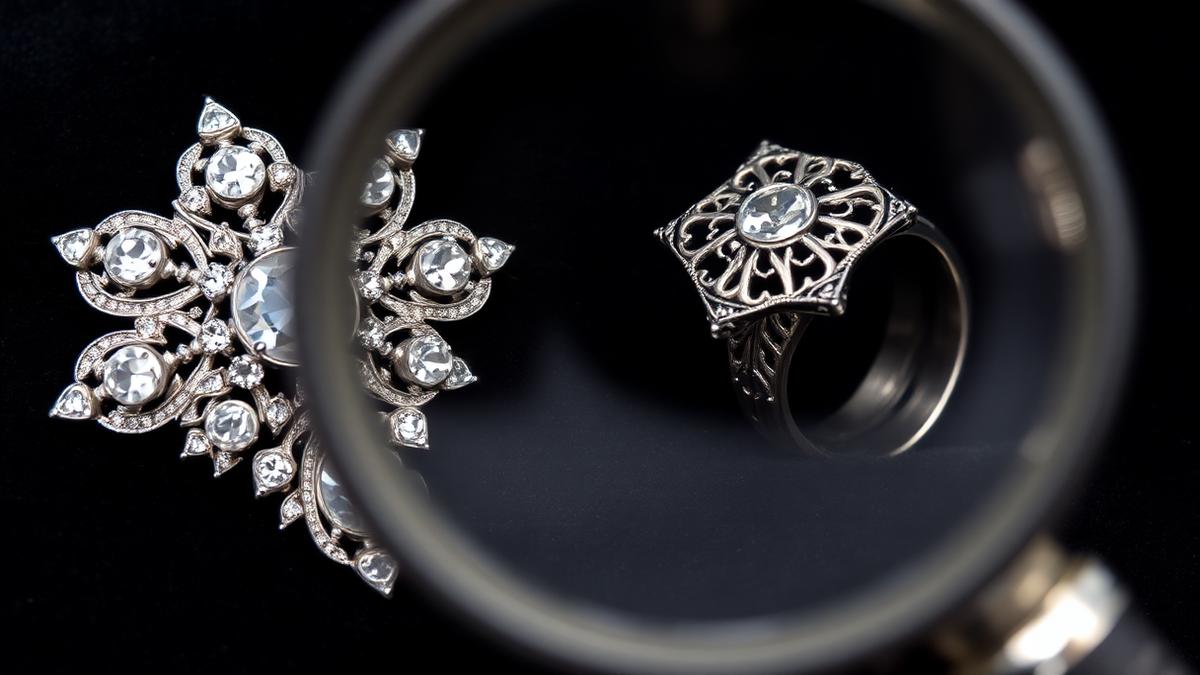
What Art Deco Actually Looks Like
Art Deco design, flourishing from roughly 1920 to 1935, was a deliberate and dramatic departure from the styles that preceded it. Its visual language is one of modernity, machinery, and global inspiration, resulting in pieces that feel both timeless and distinctly of their era. Understanding these core visual tenets is the first step in identification.
- Geometry over nature: This is the most critical characteristic. Art Deco embraces bold, symmetrical, and repeating geometric patterns. Think chevrons, ziggurats (stepped pyramids inspired by ancient Mesopotamian architecture), sunbursts, and fountain motifs. Lines are clean, straight, and angular. This stands in stark contrast to the preceding Art Nouveau period (c. 1890–1910), which celebrated sinuous, flowing, asymmetrical lines inspired by nature—whiplash curves, insects, and flowers. Edwardian jewelry (c. 1901–1915) was lighter and more delicate, often featuring garlands, bows, and lace-like patterns, but Art Deco rejected this overt romanticism for something stronger and more architectural.
- High-contrast colour: The palette is daring and confident. The stark contrast of black and white was a hallmark, typically achieved by setting black onyx or black enamel directly against diamonds and platinum. Jewelers also embraced vibrant, exotic color pairings inspired by global travel and artistic movements like Fauvism. Popular combinations include deep blue sapphire with diamond, rich red coral against green jade, and lapis lazuli paired with turquoise and platinum.
- Platinum and white gold: While yellow gold was used, especially in French pieces, the defining metal of the fine Art Deco era was platinum. Its strength allowed for the creation of delicate yet durable settings (like filigree) and its bright white color perfectly complemented diamonds. White gold, a less expensive alternative, also became popular during this time.
- Innovative stone cuts: The period saw the popularization of specific cutting styles. Diamonds were often old European cuts or transitional cuts, which have a chunkier appearance and a visible open culet (the point at the bottom of the stone) compared to modern round brilliants. Beyond the center stones, jewelers perfected the art of the calibré cut. This involved custom-cutting colored gemstones like sapphires, rubies, and emeralds into specific shapes (squares, triangles, curved sections) to fit perfectly into a design channel, creating a seamless mosaic of color set flush against the metal and other stones.
The Identification Checks That Matter
Moving from the general look to specific details requires a methodical approach and often a jeweler's loupe (a 10x magnification lens). These checks separate authentic period pieces from later reproductions and are essential for accurate valuation.
1. Read the Marks (Hallmarks and Maker's Marks)
Hallmarks are the coded language of jewelry. For Art Deco pieces, the metal purity mark is a primary clue. A stamp reading "PLAT," "PLATINUM," "IRIDPLAT," or "10% IRID PLAT" (indicating a 90% platinum, 10% iridium alloy for strength) is a powerful indicator of a genuine 1920s-30s piece. While "14K" and "18K" white gold were also used, a European numerical stamp like "585" (for 14K) or "750" (for 18K) without a corresponding K mark can sometimes suggest later, post-WWII European production. A maker's mark (e.g., "Cartier," "VCA," "Tiffany & Co.") can elevate a piece's value exponentially. Researching these marks is crucial; photograph them clearly for comparison against online databases of historical hallmarks.
2. Analyze the Diamond and Gemstone Cuts
The way the stones are cut is a time capsule. As mentioned, authentic Art Deco diamonds are typically Old European Cuts (OEC), Transitional Cuts, or even older Old Mine Cuts recycled into new pieces. These have fewer, larger facets than modern cuts, a higher crown, and a small but visible circle at the bottom called an open culet. A modern round brilliant cut, with its pinpoint culet and splintery sparkle, is a red flag that the piece is either modern or an older piece that has been altered with a replacement stone. For colored stones, look for the presence of calibré cuts—the meticulous, channel-set stones are a hallmark of high-quality Art Deco craftsmanship that is rarely replicated with the same precision today. Also, be aware of synthetic gemstones, which were fashionable and commonly used in the era. A synthetic sapphire, while period-correct, will have a lower value than a natural one.
3. Examine the Construction and Finishing
Authentic pieces were predominantly hand-finished. Look for these signs under magnification:
- Filigree: True Art Deco filigree is often hand-pierced, meaning a jeweler used a tiny saw to cut intricate patterns from a solid sheet of platinum or gold. This results in delicate, sharp-edged details. Cast filigree, common in reproductions, has a softer, more rounded appearance.
- Milgrain: This refers to the tiny beaded border applied along the edges of a setting. In period pieces, it was applied by hand with a special tool, resulting in slight, charming irregularities. In modern cast pieces, the milgrain is part of the mold and appears perfectly uniform and often less defined.
- Engraving and Galleries: Hand engraving will show minuscule variations in depth and width. The gallery (the side profile or under-side of the setting) on a fine piece is often as detailed as the top, featuring its own pierced work or engraving. Mass-produced modern pieces often have plain, unfinished galleries.
4. Check Under the Stones
Flip the piece over. In the Art Deco period, settings for both diamonds and colored gemstones were almost always open-backed. This was a functional choice to allow maximum light to enter the stone, enhancing its brilliance and color. A closed or solid back on a transparent stone is more characteristic of Victorian, Georgian, or modern costume jewelry. While not a foolproof rule, it's a strong contextual clue.
5. Test the Metal, Don't Guess
Platinum has a distinct heft; it is significantly denser and heavier than white gold or silver. An experienced hand can often feel the difference immediately. It is also non-magnetic. While these are good field tests, the definitive way to confirm is with an X-ray fluorescence (XRF) test. Most jewelers and pawn shops have an XRF analyzer and can perform this non-destructive test for you in seconds, often for free. This definitively confirms the metal's composition (e.g., 90% Platinum, 10% Iridium) without any guesswork.
Distinguishing Genuine Art Deco from Revivals
The Art Deco style has been so enduringly popular that it has been revived multiple times, primarily in the 1950s, the 1970s-80s, and today. Telling these revivals from original 1920s-30s pieces is the key to avoiding costly mistakes. The differences are often subtle but critical.
A 1980s "Art Deco Style" ring might mimic the geometry but will often be made of 10K or 14K yellow or white gold, feel lightweight due to casting, and feature modern brilliant-cut diamonds. In contrast, a genuine 1925 piece will likely be heavier platinum, feature a chunkier Old European Cut diamond, and show signs of hand-finishing like irregular milgrain. Before you make a significant purchase, it's wise to get a quick valuation. Tools like FlipAI let you take a photo of any item, and its image recognition can compare the piece against a database of confirmed Art Deco and revival pieces to provide an initial market-based estimate.
| Feature | Genuine Art Deco (1920-1935) | Art Deco Revival (1970s-Present) |
|---|---|---|
| Primary Metal | Platinum; 18K White Gold | 14K or 10K White/Yellow Gold; Silver |
| Weight & Feel | Heavy, dense (especially platinum) | Lighter, less substantial feel due to casting |
| Diamond Cut | Old European, Transitional, Old Mine, Single Cut | Modern Round Brilliant, Princess Cut |
| Construction | Hand-pierced filigree, hand-applied milgrain | Cast construction, uniform/molded details |
| Finish & Wear | Soft patina, minor wear on facet junctions | Crisp, highly polished, sharp casting texture |
| Hallmarks | "PLAT", "IRIDPLAT", period-specific maker's marks | Modern maker's marks, "14K", "585", ".925" |
Major Art Deco Jewelry Houses and Their Hallmarks
While unsigned pieces can be magnificent and valuable, a signature from a revered jewelry house acts as a guarantee of quality and multiplies the value. Identifying these marks is a critical skill. These are some of the titans of the era:
- Cartier: Perhaps the most famous. Known for their "Tutti Frutti" pieces with carved colored stones, bold platinum and diamond creations, and mystery-set gems. The hallmark is typically a script "Cartier" and a serial number. French pieces will have French eagle head (for platinum) or owl (for gold) assay marks.
- Van Cleef & Arpels (VCA): Famed for inventing the Serti Mysterieux (Mystery Setting), which uses a network of tiny gold rails to set stones without visible prongs. Their mark is often "Van Cleef & Arpels" or "V.C.A." along with a serial number.
- Tiffany & Co.: An American powerhouse, Tiffany embraced Art Deco with sleek, geometric designs in platinum. Their mark, "TIFFANY & CO.", is one of the most recognized in the world.
- Mauboussin: A Parisian jeweler renowned for its bold use of colored gemstones and avant-garde designs. Look for the "Mauboussin" signature, sometimes with "Paris."
- Raymond Templier: A key figure in French Art Deco design, Templier's work is highly architectural and almost machine-like. His pieces are rare, highly sought after, and will bear his maker's mark.
- Oscar Heyman & Brothers: Known as the "jeweler's jeweler," this New York firm created magnificent, complex pieces for many other famous houses (including Tiffany). Their own pieces are marked with a serial number and the "OHB" monogram.
Finding one of these marks transforms a piece from a beautiful antique into a work of art with established provenance. It's the difference between a $5,000 bracelet and a $50,000 one.
Realistic 2026 Value Ranges
Fine Art Deco is one of the strongest segments in the antique jewelry market, and the intrinsic value of platinum plus old-cut diamonds gives a hard floor under prices. Condition, provenance, and stone quality cause huge variations. Broad brackets for 2026 are:
Costume and Silver Pieces
- Costume Deco (base metal, paste stones, unsigned): $30–$150. These capture the style but not the material value.
- Signed Costume (e.g., Trifari, Coro, Eisenberg): $150–$600. Signatures add collector value, especially for elaborate and well-preserved pieces.
- Sterling Silver Deco (e.g., Marcasite brooches, rings): $75–$250. Popular and accessible entry point.
Fine Jewelry: Gold and Platinum
- Filigree white gold ring, small diamonds/no center stone: $400–$1,200. The classic, accessible Deco ring.
- Platinum ring, 0.5–1.0 ct old European centre diamond: $2,000–$6,000+. GIA/AGL certificate for the diamond greatly increases value and liquidity.
- Platinum ring with significant calibré-cut sapphires/emeralds: $3,500–$9,000. The complexity and color add a premium.
- Platinum line bracelet or brooch, multi-stone: $3,000–$15,000. Bracelets are particularly desirable; value depends heavily on total carat weight and complexity.
- Signed by a major house (Cartier, VCA, etc.): $10,000 to well over $1,000,000. These are auction-level pieces where the brand and artistry are the primary value drivers.
Two critical adjustments apply to everything above: a certified natural (unheated, untreated) sapphire, ruby, or emerald raises the number substantially. Conversely, a synthetic stone — which was very common and fashionable in the 1920s and 1930s, and therefore period-correct — lowers the value compared to a natural equivalent but does not make the piece "fake."
Grading Condition: What Collectors Look For
The condition of an antique piece has a dramatic impact on its value. Unlike modern jewelry, a certain amount of wear can be expected and even desirable, but significant damage or poor repairs are heavily penalized. Here is a general grading scale:
- Mint/Excellent: The piece shows almost no signs of wear. All stones are original and secure in their settings. The milgrain is crisp, hallmarks are clear, and there are no signs of sizing or repairs. These pieces are rare and command the highest premium.
- Very Good: Minor signs of wear consistent with age, such as light scratches on the metal or very slight abrasions on facet junctions (visible under 10x magnification). All major stones are original. May have been professionally and discreetly sized. This is a common and desirable grade for authentic pieces.
- Good: Visible wear, some thinning of the shank, or milgrain that is worn smooth in places. May have a few small replacement stones (e.g., melee diamonds). Might show a visible but clean solder line from a past repair. The price should reflect these imperfections, often 20-40% below a "Very Good" example.
- Fair/As-Is: Significant damage such as a cracked shank, missing stones, or a major stone that is chipped or heavily abraded. May have clumsy, obvious repairs. These pieces are valued closer to their intrinsic material value, plus a small premium for salvageable elements. Often sold as restoration projects.
Where Sellers Lose Money
The gap between a beautiful piece and a profitable sale is paved with potential mistakes. Avoiding these common pitfalls is essential for maximizing your return.
- Scrapping the piece for melt value. This is the cardinal sin. An intact Art Deco platinum ring is almost always worth multiples of its metal and stone weight. A bullion buyer will offer you perhaps $600 for a ring that a collector would pay $3,000 for. Always check resale comps first. This is where resellers find enormous value; using an app like FlipAI to scan an item at a pawn shop or estate sale can instantly highlight the difference between scrap value and true market value.
- Aggressive over-polishing. Collectors pay for originality and patina. Buffing a 100-year-old ring until it looks brand new destroys the soft finish and, more importantly, can wear away the delicate, hand-applied milgrain and engraving that are key indicators of authenticity and craftsmanship. Clean gently with soap and water, but do not re-polish.
- Misrepresenting the era in a listing. Calling a 1980s revival piece "Art Deco" is a recipe for returns, negative feedback, and a damaged reputation. If you are not 100% certain of the date, it is far better to be honest. Describe it as "Art Deco style" and let the detailed photographs of the construction, marks, and stone cuts speak for themselves.
- Poor photography. Fine jewelry needs clear, well-lit photos. You must include shots of the front, back, side profile (the gallery), and a clear, magnified image of any hallmarks or maker's marks. Without these, potential buyers cannot perform their own checks and will assume the worst, leading to lower bids or no sale at all.
Selling Your Art Deco Jewelry: Platforms and Fees
Once you've identified and valued your piece, you need to choose the right sales channel. Each has different audiences, fee structures, and timelines.
Auction Houses
Examples: Sotheby's, Christie's (for top-tier, signed pieces), Bonhams, Heritage Auctions (for fine but unsigned pieces).
Best for: Signed pieces, exceptional gemstones, items worth over $10,000.
Seller's Commission: Typically 10-25% of the hammer price, on a sliding scale. Plus fees for insurance, photography, and marketing.
Pros: Access to high-end global collectors, expert authentication, high prices realized for top lots.
Cons: Very selective, long lead times (months), high fees.
Specialized Online Marketplaces
Examples: 1stDibs, Ruby Lane, The RealReal.
Best for: Good quality, authenticated pieces from $500 to $20,000.
Seller's Commission: Varies wildly. 1stDibs charges a monthly fee plus commission (~15%). The RealReal uses a tiered commission structure from 15% to 60% based on the item's value.
Pros: Curated platforms with a trusting buyer base. They handle authentication and listing.
Cons: High commission rates can eat into profit. Strict acceptance criteria.
Peer-to-Peer Platforms
Examples: eBay, Etsy.
Best for: All levels, from costume to fine jewelry. You control the listing and price.
Seller's Commission: eBay is typically around 13.25% for jewelry, plus listing fees. Etsy charges transaction, listing, and payment processing fees that add up to around 10%.
Pros: Massive audience, lower fees than curated sites, full control over your sale.
Cons: You are responsible for everything: authentication, photography, description, shipping, and dealing with returns. Higher risk of fraud. For more tips on navigating these platforms, check out our comprehensive reseller guide.
How to Get a Value Fast
Marks and stone cuts narrow the era; live market prices from the market set the final number. The fastest way to a preliminary valuation is to use a market data tool. With FlipAI you can take a photo of any item or scan its barcode and get an estimated resale range from real-time market data. The app's image recognition compares your item to a database of thousands of sold Art Deco jewelry listings, giving you a powerful data point before you commit to a buy price or set a listing price.
For any piece you believe is platinum with a center stone over half a carat, or if you suspect it's a signed piece, you must pair that digital estimate with an in-person opinion from an independent GIA-certified appraiser. A formal appraisal for insurance or resale purposes can cost $100-$300, but the financial difference between a natural and a synthetic sapphire, or an Old European cut and a modern brilliant, can be thousands of dollars, making the fee a sound investment.
Planning to resell? Always run your potential margin in a free profit calculator first. Fine jewelry carries non-negotiable costs like insured shipping and signature confirmation that a simple flat-rate estimate will miss, significantly impacting your net profit.
Bottom Line
Authentic Art Deco jewelry is a fantastic category for collectors and resellers, rewarding deep knowledge with significant value. The four key signals of a genuine piece are its stark geometry, the presence of platinum or 18K gold marks, period-correct old-cut diamonds, and evidence of hand-finishing like irregular milgrain and pierced filigree. Revivals are common, so learning to spot the differences in construction, metal weight, and stone cuts is paramount.
Genuine Art Deco holds its value exceptionally well, often appreciating over time, so the effort spent on identification is always rewarded. The pieces most often overlooked and undervalued are unsigned platinum rings and brooches sitting in generalist antique shops or estate lots. By carefully applying these identification checks and leveraging modern tools to analyze market data, you can uncover these hidden gems and confidently assess their true worth. For a broader overview of valuation techniques across different categories, see our guide on how to find what anything is worth.
Frequently asked questions
What's the easiest way to tell real Art Deco from a revival piece?
Look at the diamond cut and the overall weight. A genuine 1920s-30s piece will likely have an 'Old European' or 'Transitional' cut diamond with a chunky appearance and a visible circle (culet) at the bottom. A modern revival will almost always use a 'Modern Round Brilliant' cut. Additionally, authentic platinum pieces feel significantly heavier and denser than their white gold or silver revival counterparts.
Is Art Deco jewelry always made of platinum?
No. While platinum was the preferred and most iconic metal for fine Art Deco jewelry due to its strength and bright white color, 18K and 14K white gold were also widely used as more affordable alternatives. High-end French pieces sometimes used yellow gold. Sterling silver was common for less expensive items like marcasite brooches.
How much is a typical Art Deco engagement ring worth?
Value varies greatly. A simple 14K white gold filigree ring with small diamond chips might be $400-$1,200. A classic platinum ring with a 0.5 to 1.0 carat Old European cut diamond centerpiece typically falls in the $2,000 to $6,000 range. If the ring is signed by a major house like Cartier or Tiffany, the value can easily exceed $10,000.
Does a synthetic stone mean my Art Deco jewelry is fake?
No, not at all. Synthetic rubies and sapphires were a new and exciting technology in the 1920s and were frequently used by fine jewelers. Finding a synthetic stone in a piece is period-correct and helps confirm its age. However, it does affect value; a piece with a synthetic gem will be worth less than an identical piece with a natural, untreated gem of the same size and quality.
What are the most famous Art Deco jewelry brands?
The most revered Art Deco jewelry houses include French Maisons like Cartier, Van Cleef & Arpels, Mauboussin, and Raymond Templier, and American powerhouses like Tiffany & Co. and Oscar Heyman & Brothers. A hallmark from one of these makers guarantees exceptional quality and can increase the item's value exponentially compared to an unsigned piece.
Frequently Asked Questions
What's the easiest way to tell real Art Deco from a revival piece?
Look at the diamond cut and the overall weight. A genuine 1920s-30s piece will likely have an 'Old European' or 'Transitional' cut diamond with a chunky appearance and a visible circle (culet) at the bottom. A modern revival will almost always use a 'Modern Round Brilliant' cut. Additionally, authentic platinum pieces feel significantly heavier and denser than their white gold or silver revival counterparts.
Is Art Deco jewelry always made of platinum?
No. While platinum was the preferred and most iconic metal for fine Art Deco jewelry due to its strength and bright white color, 18K and 14K white gold were also widely used as more affordable alternatives. High-end French pieces sometimes used yellow gold. Sterling silver was common for less expensive items like marcasite brooches.
How much is a typical Art Deco engagement ring worth?
Value varies greatly. A simple 14K white gold filigree ring with small diamond chips might be $400-$1,200. A classic platinum ring with a 0.5 to 1.0 carat Old European cut diamond centerpiece typically falls in the $2,000 to $6,000 range. If the ring is signed by a major house like Cartier or Tiffany, the value can easily exceed $10,000.
Does a synthetic stone mean my Art Deco jewelry is fake?
No, not at all. Synthetic rubies and sapphires were a new and exciting technology in the 1920s and were frequently used by fine jewelers. Finding a synthetic stone in a piece is period-correct and helps confirm its age. However, it does affect value; a piece with a synthetic gem will be worth less than an identical piece with a natural, untreated gem of the same size and quality.
What are the most famous Art Deco jewelry brands?
The most revered Art Deco jewelry houses include French Maisons like Cartier, Van Cleef & Arpels, Mauboussin, and Raymond Templier, and American powerhouses like Tiffany & Co. and Oscar Heyman & Brothers. A hallmark from one of these makers guarantees exceptional quality and can increase the item's value exponentially compared to an unsigned piece.